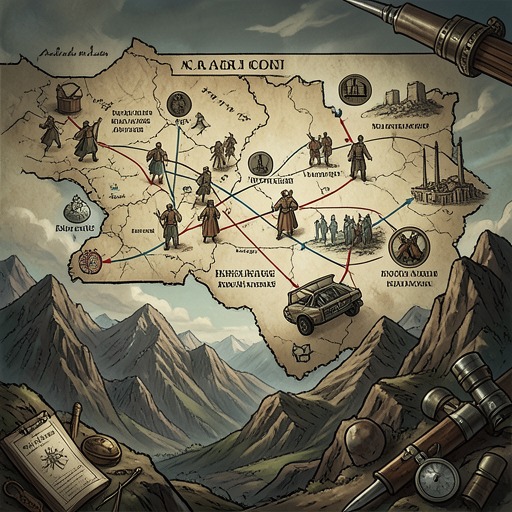
Coriantumr
Book of MormonCoriantumr is the final great combatant in the Jaredite record, a ruler whose personal endurance becomes inseparable from the extinction of his civilization. His story is preserved within the abridgment from the record of Ether, a record presented as a warning to the remnant of the house of Israel and as evidence of the consequences that follow when societies abandon covenantal order. Coriantumr does not receive a peaceful restoration or a triumphant return: he survives the last struggle only after immense loss, and his apparent defeat leaves the Jaredite world emptied around him.
Identity and Historical Setting
Coriantumr belongs to the Jaredite history recorded by Ether. That history is set against the earlier scattering of the people who built the tower to get to heaven, when the Lord confounded their language. The Jaredite record is therefore framed as part of a much larger history of migration, judgment, covenant, and national collapse. Its purpose is not merely to preserve the name of a king, but to show what the Lord had done for earlier generations and to testify that the divine purposes extend across nations.
The wider record also connects Jaredite history with the histories of the Nephites, Lamanites, and the house of Israel. The people of Zarahemla, for example, are described as having come from Jerusalem when Zedekiah, king of Judah, was carried captive into Babylon, while the Nephites and Lamanites are divided by a wilderness running from east to west. Against these interwoven migrations, Coriantumr represents the last surviving center of an older people. His presence in the concluding Jaredite scenes makes him a historical bridge: the fate of one civilization becomes a warning that later peoples can read.
Ether’s Record and the Prophetic Horizon
Coriantumr’s story reaches the reader through Ether, who records the final Jaredite crisis while dwelling in the cavity of a rock. In the first year of that retreat, many people were already gathered into the destructive conflict that would define the end of the nation. Ether’s position is both immediate and distanced: he witnesses the collapse from concealment, while the record preserves the events for generations that will never see the Jaredite world firsthand.
The account places the war within a prophetic horizon. Ether saw the days of Jesus Christ and spoke of a New Jerusalem upon the land. The contrast is severe. The same historical landscape that holds the promise of a future sacred city also holds the disintegration of a people through internecine war. Coriantumr’s survival thus cannot be read simply as rescue. It is survival after the order that gave his kingship meaning has been consumed.
The Final War and Coriantumr’s Wounds
The final struggle brings Coriantumr into direct collision with Shiz and the forces opposing him. In the battle, Coriantumr receives many deep wounds. He loses so much blood that he faints and is carried away as though he were dead. The bodily detail is central to his characterization: the king is not removed from the catastrophe by authority, distance, or symbolic grandeur. He is reduced to a wounded body amid a battlefield where the distinction between the living and the dead has become uncertain.
The cost of the encounter is measured collectively as well as personally. The loss of men, women, and children on both sides is so great that Shiz orders his people not to pursue Coriantumr’s armies; they return to their camp instead. The withdrawal is not a clean military victory. It is a pause forced by exhaustion and devastation, and it reveals that the conflict has consumed the ordinary population along with the combatants. Coriantumr’s wounds are therefore part of a national wound: his body registers the violence that has overtaken the entire Jaredite society.
When Ether 15 begins, Coriantumr has recovered sufficiently for the account to continue, but recovery does not restore what has been lost. The narrative keeps him within the motion of the war rather than allowing convalescence to become a new beginning. His return to the struggle suggests the tragic circularity of the conflict: injury interrupts the violence, but does not end it. The king’s capacity to rise again becomes one of the mechanisms by which the war continues.
Defeat, Survival, and Ending
At the close of the recorded battle, Coriantumr again falls to the earth and becomes as if he has no life. The phrasing repeats the earlier uncertainty surrounding his death. He is neither given a clear heroic death nor presented as securely victorious. Instead, his ending remains poised at the boundary between life and death, a fitting condition for the last known ruler of a destroyed people.
This suspended ending gives Coriantumr a significance beyond individual biography. The Jaredite record is an abridgment, sealed and hidden up to the Lord, brought forth by the gift and power of God in due time. Coriantumr’s near-death state mirrors the record’s larger historical condition: a civilization appears lost, yet its testimony survives in fragmentary form. The king remains as a remnant, while the record becomes the durable witness to what the people themselves could not preserve.
Narrative Significance
Coriantumr is best understood as a tragic survivor rather than a conventional hero. His arc contains ordeal and endurance, but it does not culminate in the restorative return commonly associated with heroic narratives. The movement is instead from kingship into ruin, from command into bodily helplessness, and from individual survival into the disappearance of a civilization. Whatever power he possesses cannot convert military persistence into communal salvation.
The character also concentrates the book’s recurring pattern of catastrophe followed by promised renewal. The Jaredite scattering begins with the confusion of language; Ether’s vision looks forward to the days of Jesus Christ and the establishment of a New Jerusalem; Coriantumr’s final struggle occupies the devastated interval between those poles. His story warns that survival alone is not redemption. A remnant may remain to bear witness, but reconstruction requires a different order than the one represented by endless war.
Through Coriantumr, the narrative turns military history into moral memory. The final battles are not presented as isolated contests between kings: families and children perish, armies return to camp because the losses are too great, and the ruler himself repeatedly lies as though dead. His fate makes the Jaredite record a cautionary counterimage to the promised gathering and future renewal of the house of Israel. Coriantumr endures long enough for the catastrophe to be remembered, but not long enough to escape its meaning.